
Biofactory and bokashi on the farm: how to start making your own fertility
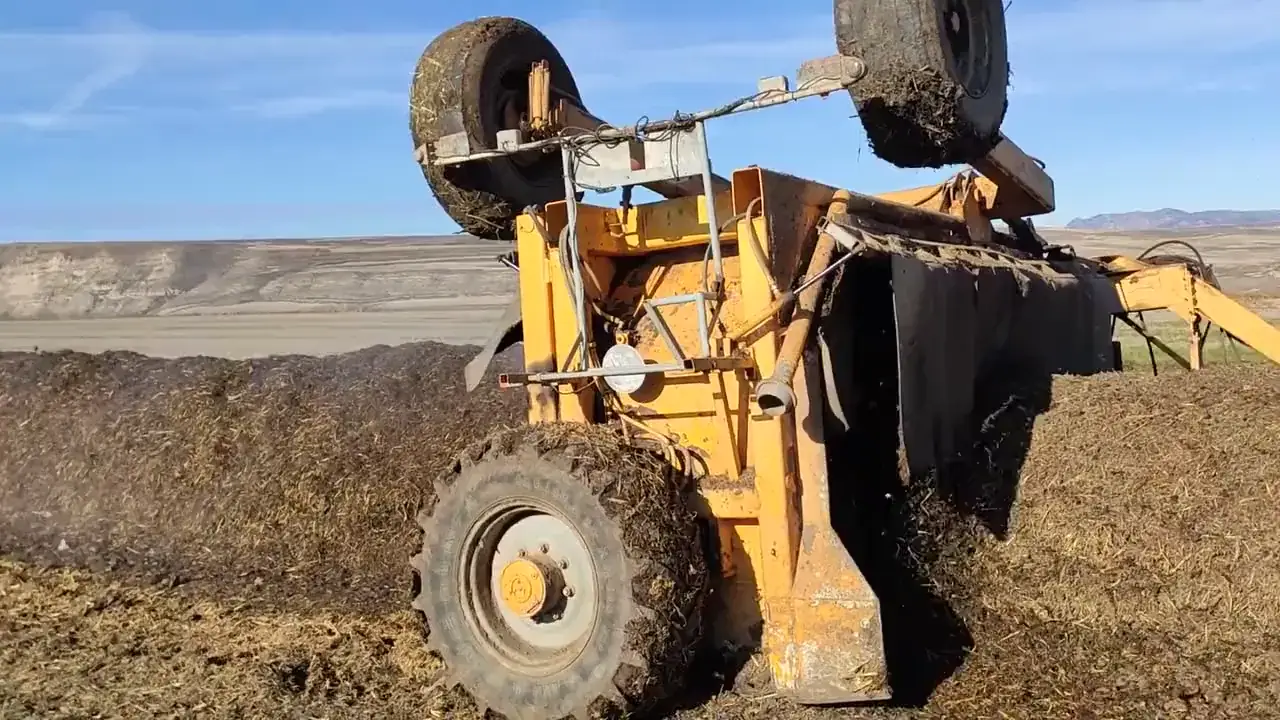
More and more farmers ask us the same thing: "Can I stop buying part of what I put on the soil and make it myself?" The short answer is yes, with method. That is what a biofactory is: a corner of the farm where you turn residues and by-products into biological inputs for your soil. And bokashi is usually the way in.
What is an on-farm biofactory?
It is the space and the routine a farm uses to produce its own biological inputs. To start, all you need is:
- A covered, tidy spot, protected from direct sun and rain.
- Local materials: crop residues, straw, dry manure, soil and whatever the farm or its surroundings produce.
- Records: what you do, when, with what and where you apply it.
FAO, in its 10 elements of agroecology, explains that recycling nutrients, biomass and water within the farm reduces dependence on external resources and makes producers less vulnerable to market and climate shocks.
Two different things with the same name
"Bokashi" is used for two different techniques, and it is worth keeping them apart.
Bucket bokashi. Washington State University (WSU) Extension describes it as an oxygen-free fermentation of organic scraps in a closed container, using bran inoculated with lactic acid bacteria, yeasts and phototrophic bacteria. The result is an acidic "pre-compost" that must be buried mixed with two to three times its volume of soil, waiting at least two weeks before planting (three to four in cold or compacted soils). The University of Saskatchewan adds that the area can take six to eight weeks to become safe for planting. It is useful for household kitchen scraps.
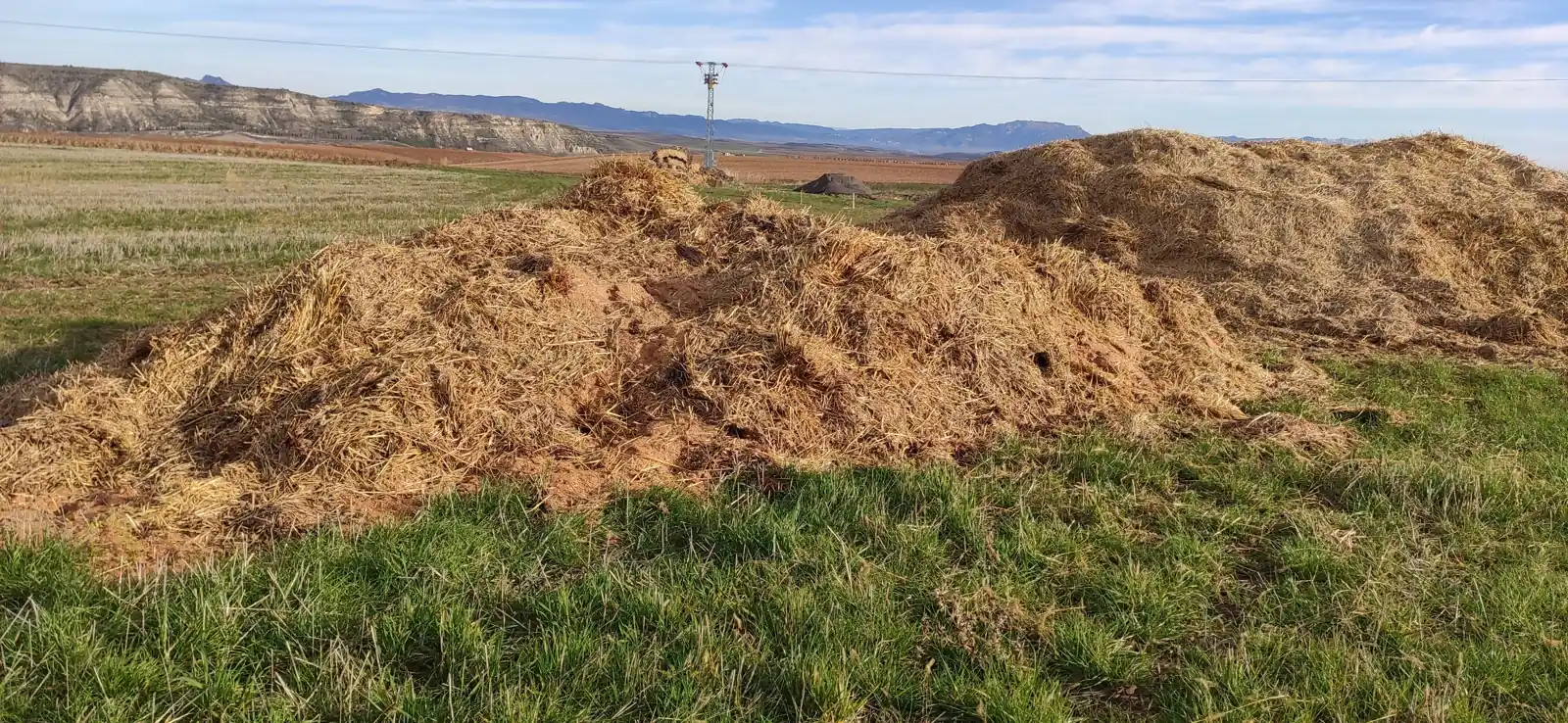
Pile bokashi. This is fermented manure at farm scale. The practical bio-input manuals of Mexico's Ministry of Agriculture and INIFAP describe it as a fertiliser prepared by mixing manures, plant residues and other materials in specific proportions, with additives that speed up fermentation, and which is usually ready in 12 to 21 days depending on the climate. This is the one you want for fertilising plots.
Pile bokashi recipe for one tonne
This formulation follows manual no. 8 of that series. Quantities are given in 50 kg sacks, and you can scale them up while keeping the proportions.
Ingredients
- Dry manure: 7 sacks. Sheep, cow, goat, horse or poultry will do. Never fresh, and never pig manure.
- Dry straw or stubble, finely chopped: 7 sacks.
- Forest soil or compost: 7 sacks. It gives uniformity and spreads moisture.
- Rice husk: 5 sacks. It adds aeration and structure.
- Crushed charcoal: 2 sacks.
- Rock dust: 1 sack.
- Inoculum: 500 g of yeast and 2 litres of molasses.
- Chlorine-free water, as needed.
Building the pile
- The day before, dissolve the molasses and yeast in about 15 litres of lukewarm water and leave the mixture overnight.
- Work under cover if you can: rain is the pile's great enemy.
- Build layers in this order: straw, manure, soil, rock dust, husk and charcoal. Water each layer with part of the inoculum and about 10 litres of water, and repeat until the materials are used up.
- Mix the whole pile with a fork until it is uniform.
- Do the fist test: squeeze a handful. It should not drip or feel dry, but fresh and mouldable. If it drips, add dry soil.
- Cover the pile with a plastic sheet held down with stones.
Turning and temperature
The manual proposes a schedule of about 17 days:
- Days 1 to 7: turn twice a day, morning and afternoon.
- Days 8 to 17: turn once a day.
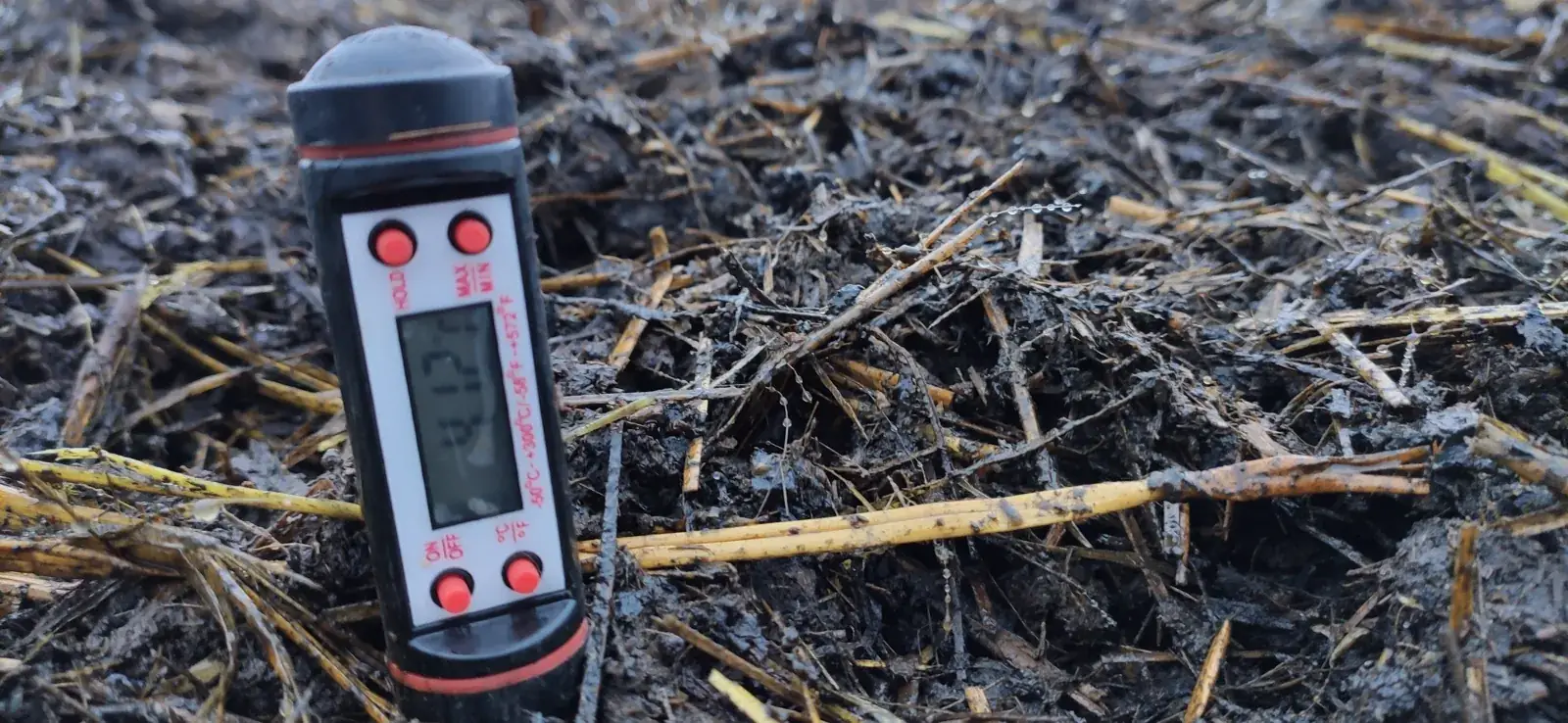
Measure the temperature at every turn with a probe thermometer. In the first week it rises to about 50 °C and should not go higher: if it does, turn three times a day until it drops. After that it will fall on its own. One important rule: don't add water while turning, and don't skip a day.
When it is ready
According to the manual, mature bokashi:
- is at ambient temperature,
- smells fermented, with a slight scent of forest soil,
- has its materials largely broken down, around 80%,
- has a pH between 7.8 and 8.8.
How to apply and store it
- Dose: the INIFAP manual gives an indicative minimum of 1 kg per m², about 10 t/ha. Because many soils are badly degraded, at True Regenerative we have run our own field trials with up to 100 t/ha, and we have seen that the more bokashi is applied, the better the soil and the crop respond. On another farm we support, we applied 60 t/ha on the most degraded plots, which responded best, and 30 t/ha on those in better condition; the difference of applying more was very visible in the crop. On a rice paddy we support, we applied up to 30 t/ha and the rice did very well, with a harvest of about 4 t/ha. The right dose for each farm depends on how fast you want to regenerate the soil and the budget you want to put into the transition.
- Timing: about 15 days before sowing or transplanting.
- In an established crop: in furrows or beds, about 15 cm from the plants.
- Seedbeds: 1 kg of bokashi for every 10 kg of other substrates.
- Storage: in sacks labelled with the date, in a cool, dry place. Best used within a year.
Common mistakes
- Making the pile too wet. If it drips when squeezed, correct it with dry soil.
- Letting it go above 50 °C. Turn more often.
- Skipping turns in the first week.
- Using fresh manure.
- Confusing bucket bokashi with pile bokashi. Bucket bokashi is never left on the surface.
- Not writing anything down. Without records you won't know what worked.
Start small, learn fast
A biofactory starts with a first pile, a trial plot and a notebook where you record dates, temperatures, doses and results. As the NRCS of the US Department of Agriculture reminds us, minimising soil disturbance, keeping the soil covered, encouraging biodiversity and keeping living roots are the basis of a healthy soil. Bokashi adds value within that system.
If you want to design your farm's biofactory around your materials, your crops and your climate, write to us.
Be the one who does it.
Sources
- Ministry of Agriculture and Rural Development (Mexico) and INIFAP, Technical Support Strategy (2021). Manuales prácticos para la elaboración de bioinsumos. 8. Elaboración de Bocashi (in Spanish). Included in Jairo Restrepo's course material; the manual lists Restrepo among its references.
- Restrepo, J. (2007). Manual práctico: el ABC de la agricultura orgánica y harinas de roca (in Spanish). Managua: SIMAS. Cited in the manual above.
- Washington State University Extension, Kitsap County. Bokashi Composting. https://extension.wsu.edu/kitsap/bokashi-composting/
- University of Saskatchewan, College of Agriculture and Bioresources. Bokashi composting (indoor method). https://gardening.usask.ca/articles-and-lists/articles-healthysoils/bokashi.php
- FAO. The 10 elements of agroecology: Recycling. https://www.fao.org/agroecology/overview/the-10-elements-of-agroecology/recycling/en
- USDA NRCS. Soil Health. https://www.nrcs.usda.gov/conservation-basics/natural-resource-concerns/soil/soil-health