Context
Soil, water, climate, economics and team. What can be done here, not in a generic slide deck.
We don’t guess what the soil is doing. A chromatography plate and the lab tubes show it — life, a blockage, an imbalance — and only then does management change. Look first, then measure, then decide: that way you depend neither on a trend nor on us.

Six steps, in this order. Skip the measurement and the rest is opinion. At the end the team makes, observes and adjusts without us.
Soil, water, climate, economics and team. What can be done here, not in a generic slide deck.
Home-made bio-inputs, cover, living roots, diversity, animals where they fit, and balanced plant nutrition (less “kill the pest”, more healing the metabolism). Microbiology is the foundation: it turns organic matter and minerals into nutrients the plant can absorb.
Keyline and water management so regeneration does not dry out in the first drought. Harvesting water so biology has something to work with.
Lab analyses, chromatography, Pfeiffer sensitive crystallisation and field observation. Decisions based on evidence, not trends.
We train the team to make, observe and adjust. Less and less outside dependence.
Every step has to make business sense and hold up in the farm’s accounts.
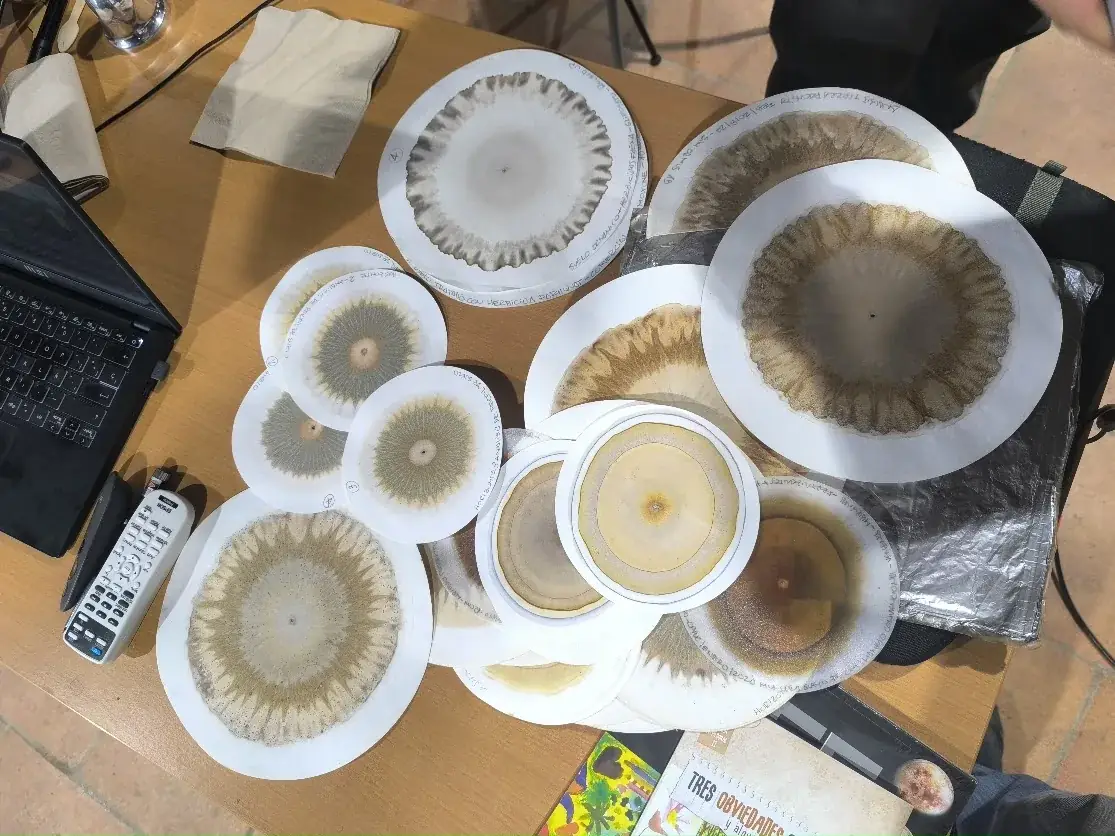
We use circular soil chromatography — a technique associated with Ehrenfried Pfeiffer and spread in Latin America by Jairo Restrepo Rivera (with Sebastião Pinheiro: Cromatografía: imágenes de vida y destrucción del suelo) — as a qualitative, visual reading of soil quality: how organic matter, minerality and biological activity relate in a pattern comparable over time.
Learning: Xavier learned this practice with Jairo Restrepo. True Regenerative has no commercial relationship with Restrepo and no endorsement from him; we cite the school we actually work with.
Reference — Book and training at La Mierda de Vaca · Cromatografía: imágenes de vida y destrucción del suelo (Jairo Restrepo Rivera & Sebastião Pinheiro) and the chromatographic analysis course. The book’s reference chromatograms are © their authors — we do not republish them here without permission.
What it is for on the farm
Limits: it is a qualitative tool for diagnosis and teaching. It does not replace quantitative analyses (organic matter, nutrients, metals, residues, etc.) or a carbon MRV against an external standard. At True Regenerative we combine it with lab work and field observation; we don’t sell invented “certificates” based on a chromatogram.
In projects such as the transition of the Tormantos vegetable farm, chromatography helped read a soil poor in microbiology, heavily mineralised and out of balance, and prioritise rebuilding living fertility alongside other documented measures.
Besides circular chromatography, we work with sensitive crystallisation with copper chloride (method developed by Ehrenfried Pfeiffer with Erika Sabarth): a qualitative image that helps attend to form and the perceived quality of extracts (soil, compost, juices / foods, according to protocol).
What we use it for: teaching and visual comparison over time; training the team’s eye alongside lab and field work. It is a qualitative diagnostic complement, not an ISO label.
Limits — Crystallisation is a real physical phenomenon; reading it as “vitality” needs judgement and training. It does not replace HPLC, microbial counts or quantitative analytics. We do not present it as conclusive proof of nutritional quality nor as a commercial certificate.
We work plant nutrition as a management axis: not only soluble NPK, but mineral balance, soil biology and plant metabolism. In that line we use Francis Chaboussou’s frame (the theory of trophobiosis): many pests and diseases thrive when the sap offers a favourable “menu” — e.g. excess free amino acids from imbalances, stress or certain practices —; a well-nourished, metabolically balanced plant is less attractive. Chaboussou describes two states. In proteosynthesis, the plant builds amino acids and sugars into proteins and tissue, and resists better. In proteolysis, breakdown dominates: free amino acids and sugars remain in the sap, the food many insects and fungi are looking for.
In practice
Limits: trophobiosis is a very useful practical compass, not a single law. Climate, variety, natural enemies and inoculum pressure also matter. We don’t promise “zero pests”, nor do we replace the agronomic and regulatory criteria for each crop.
Tell us about your farm. You’ll get a clear diagnosis and a plan you can keep up.